

Black absorbs everything. When you wear a full dark look, your outfit stops providing visual information on its own — which means every piece of jewelry you put on becomes one of the main sources of light and structure in the frame. That’s not a problem to solve so much as a starting point to work with, once you’ve experimented with a few basic ideas.
This guide covers necklace placement by neckline type, metal and fabric pairings, finish choices, layering spacing, and a section on styling with fewer, bolder pieces. Each section is self-contained. You can try one idea at a time, or combine a few once they feel familiar, and skip anything that doesn’t match your own taste.
Necklines
The neckline of your top or dress often shapes where the eye lands on a dark silhouette. Without patterns or color breaks, the fabric edge tends to become the main visual line — and a necklace can either follow that line or sit against it.
Different collar shapes pair differently with chain lengths. These are starting points to experiment with, not fixed requirements:
- Turtleneck: A longer chain that sits below the bust can create vertical movement and keep the neckline from feeling heavy.
- Boat neck: A shorter piece that rests near the throat can echo the horizontal line of the collar rather than cut across it.
- Deep V-neck: A mid-length chain can sit inside the open space of the V rather than bumping into the fabric edge.
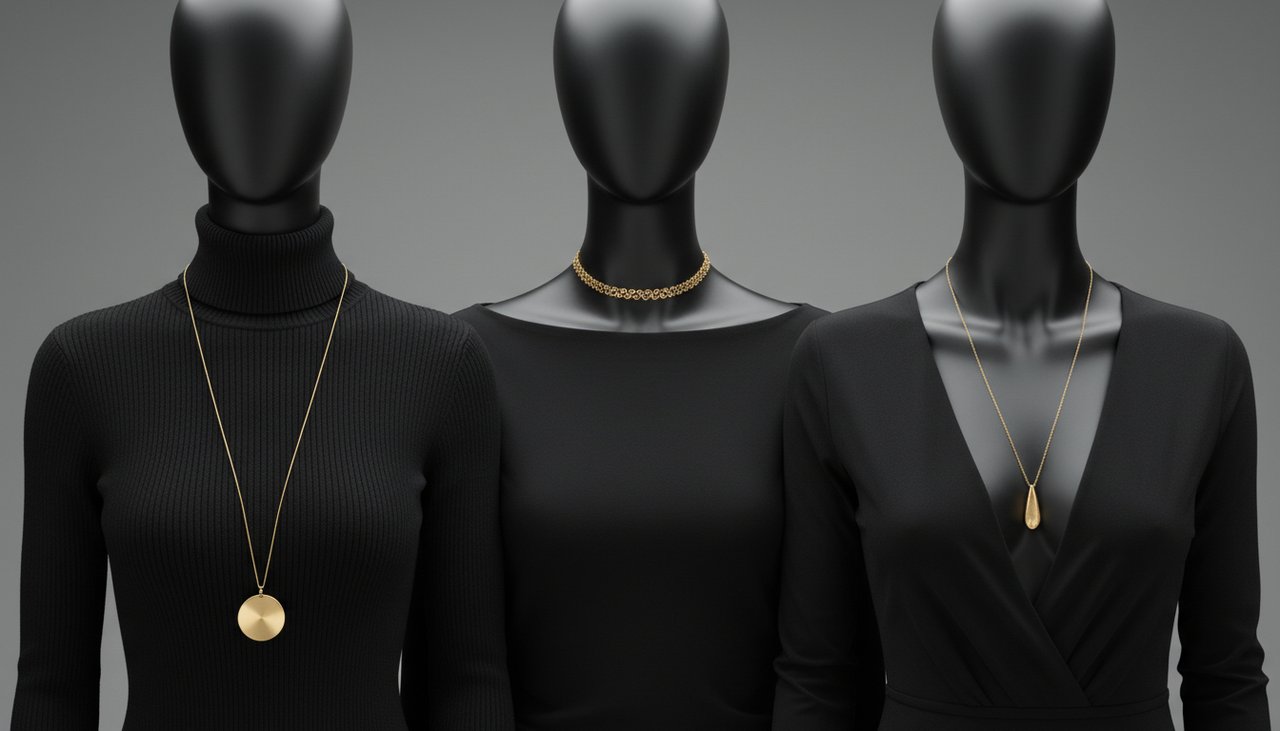
For V-necklines, some people start with a pendant sitting roughly three to five centimeters above where the fabric meets, then adjust from there based on the pendant’s shape and how it moves.
That gap is a small detail, but it’s an easy one to adjust if a pendant feels too close to the fabric or gets in the way as you move.
Skin or Fabric
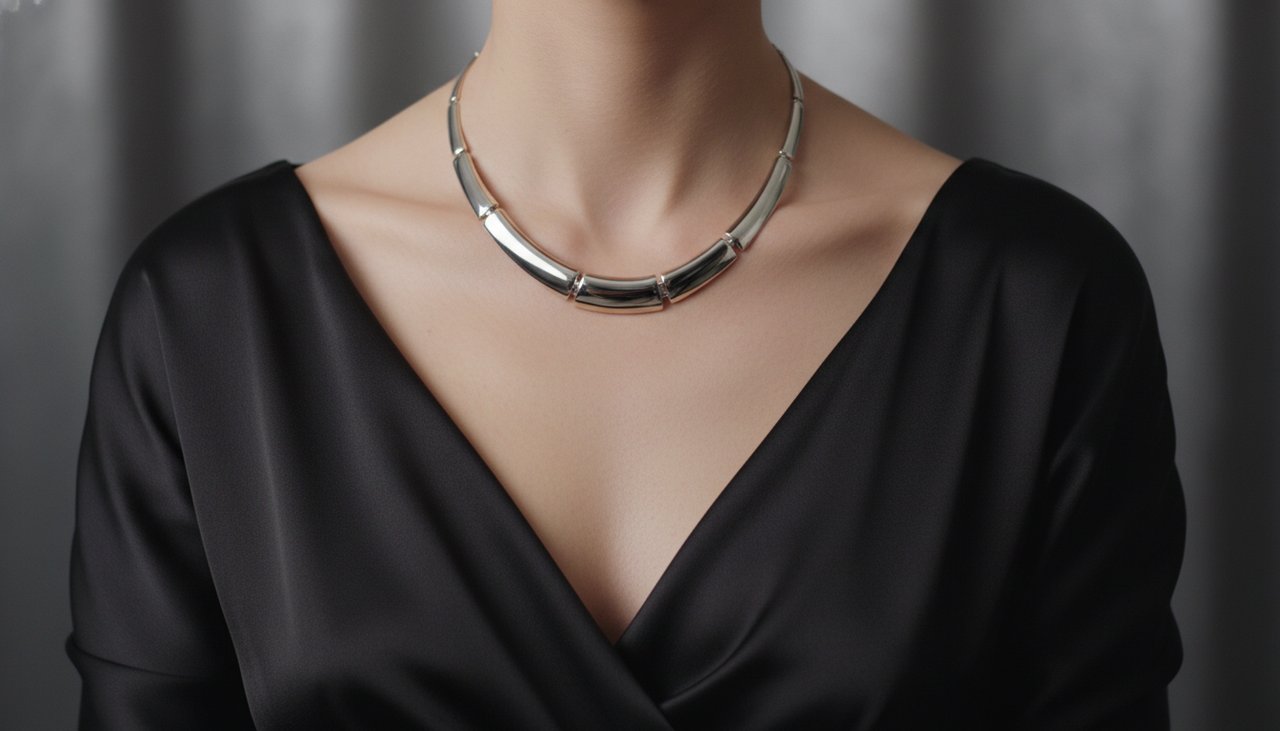
One approach some people find useful is letting a piece rest against skin rather than against the cloth. Metal against skin can pick up warmth and read differently from the same metal sitting directly on black fabric, where it can look flatter by comparison.
This is one reason shorter necklaces are often chosen for crew necks — the chain rests on the collarbone rather than on the sweater. It’s also part of why chokers over turtlenecks can look busier to some eyes — the metal sits against a fabric surface instead of skin.
When you’re layering pieces or picking a length, the balance between skin and fabric is one factor worth considering alongside the style of the piece itself.
Metal and Fabric
The texture of your black clothing can change how a metal reads. A shiny gold chain on velvet can look noticeably different from the same chain on a cotton-jersey tee, largely because of what’s behind it rather than the chain itself.
Here’s how some common fabric types are often paired with different metals, worth trying rather than treating as fixed:
| Fabric | Yellow Gold | Silver / White Gold | Rose Gold |
|---|---|---|---|
| Velvet, heavy knit | Often reads as warm — the fabric’s depth pulls shadows, which can make gold appear to glow more | Can feel cooler against a soft texture | Tends to work well; a softer contrast than yellow gold |
| Matte crepe, cotton | A subtler warmth | Can look crisp — flat surfaces often show clear contrast | A gentler option for minimal looks |
| Silk, satin | Both metals can work — the fabric’s own sheen does much of the work | Both metals can work — the fabric’s own sheen does much of the work | A softer read than gold or silver for some |
| Leather, denim | Can read as more dressed-up | Can read as more casual | Less common in this pairing, though it can work for relaxed looks |
One idea worth experimenting with: if your outfit fabric is soft and textured, warmer metals sometimes complement it; if the fabric is flatter and more structured, cooler metals sometimes create a clearer contrast.
Finish and Weight
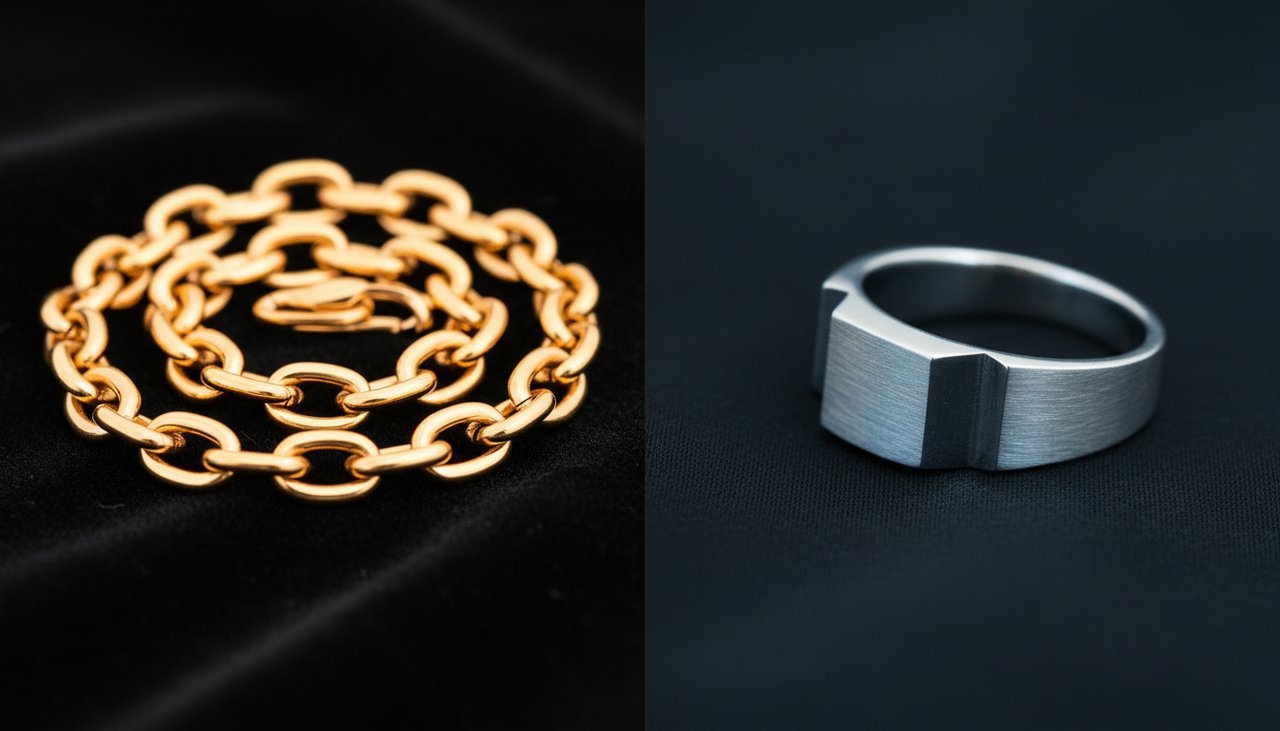
Two pieces with the same metal and shape can still look different depending on their surface finish. On a dark background, finish can influence whether a piece draws attention through texture or through shine.
A brushed finish scatters light rather than reflecting it in one direction. This can create a muted, understated look. Some people prefer this for everyday wear, where the jewelry is present without necessarily being the first thing noticed.
A high-polish finish concentrates light into a sharper reflection. On a dark outfit, this can create a visible flash that feels more attention-drawing. Some people find that one high-polish piece against all-black is enough for them, and that stacking several polished pieces on a dark background can compete for the same focal point.
One thing worth trying: mixing finishes within an outfit rather than repeating the same one, just to see how it reads.
Layering
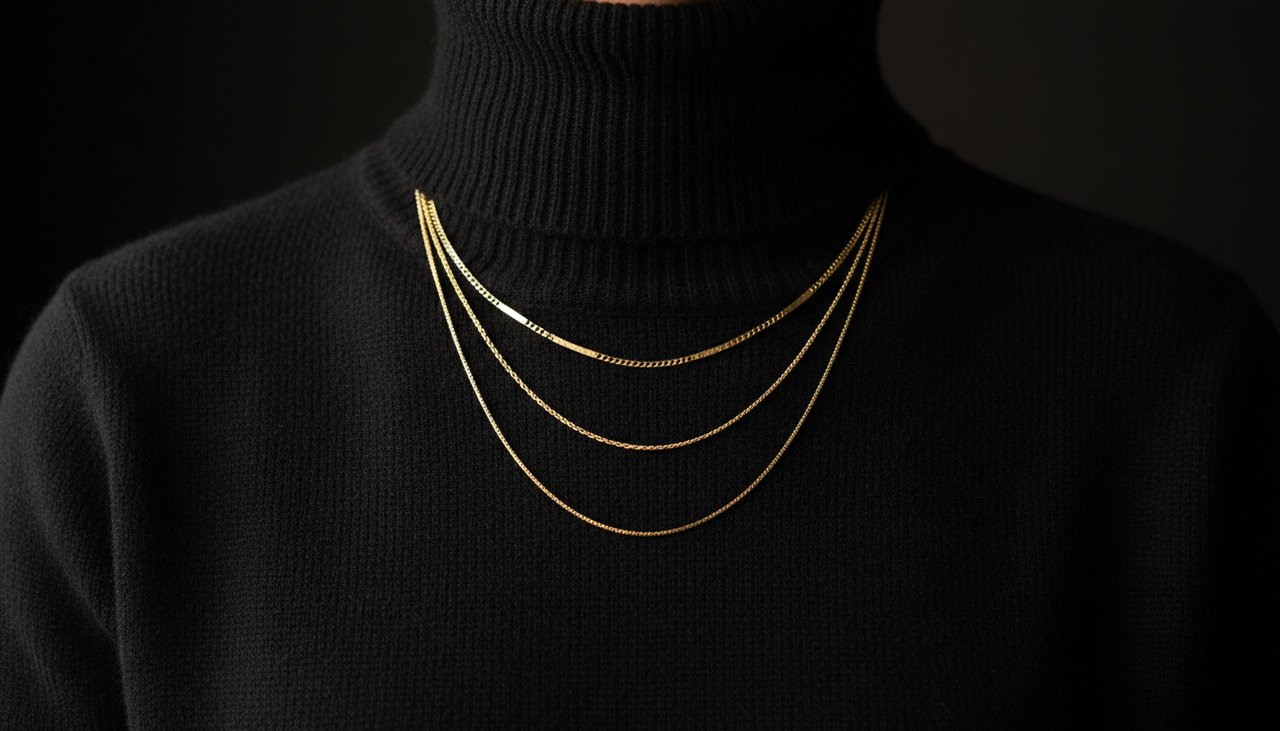
Layering chains on a dark background can work well, but dark fabric also makes overlaps and tangles more visible. Without any planned spacing, several necklaces on a black sweater can start to look like a single knot rather than a deliberate stack.
One starting point some people use: leaving roughly 1.5 to 2 inches of drop between each chain, then adjusting from there depending on the chain styles involved and personal preference.
One goal some people aim for in layering is having each strand read as individually visible. If it’s hard to tell where one chain ends and the next begins, increasing the spacing is one option to consider.
Mixing finishes when layering is another idea some people find helpful — a brushed chain next to a polished one can give the eye something to differentiate, even when the lengths are close together.
If chains end up tangled, laying them flat on a hard surface before working on them, rather than trying to untangle them while wearing them, tends to make the process easier. Two pins or toothpicks used gently from the center of the knot outward, rather than pulling from the ends, can help loosen a tangle without tightening it further.
Fewer, Bolder Pieces
A plain black outfit — a crew neck tee, dark trousers, a black jacket — is a common everyday choice, and it’s a complete look on its own with or without jewelry. For anyone who wants to add something, a single piece chosen deliberately is one way to introduce a bit of visual interest without adding much visual noise.
The same ideas from earlier sections apply here too — metal and fabric contrast, skin versus fabric, spacing between pieces — just with an emphasis on fewer, more substantial pieces rather than several smaller ones.
Chains: A single chain somewhere in the range of 18 to 24 inches is one option that tends to sit cleanly on many necklines. On a black crew neck, a chain resting on the skin above the collar can provide contrast on its own. Heavier link styles, like a Cuban or figaro chain, are sometimes chosen for more structured fabrics, while thinner chains can work across a wider range of outfits.
Rings: A black outfit is one of the plainer backgrounds to style a statement ring against, since there’s little competing pattern or color. Some people prefer one ring with visual weight — a wide band, a signet style, a textured surface — over several thinner rings. If you do stack rings, the same spacing idea from layering necklaces can apply: leaving visible gaps between pieces.
Bracelets: A single metal bracelet or cuff worn alone is one straightforward option. Mixing a metal bracelet with a cord or leather piece is another approach some people use for a deliberate material contrast. Keeping to no more than two different materials on the same wrist is one way to avoid the combination feeling busy against a plain dark background.
A simpler outfit tends to leave more room for a single chosen piece to stand out, for anyone who likes that approach.
Where to Start
If you’re building a black outfit and aren’t sure where to begin with jewelry, here are three combinations to consider as starting points rather than fixed answers:
- Casual daily wear: One brushed silver or gold chain at a mid-length, on a crew or V-neck. This tends to work across a range of fabrics.
- Evening or dressed-up: A single high-polish piece against skin — at the collarbone, on the wrist, or as one ring. Letting it be the only piece with noticeable shine is one way to keep the look focused.
- Layered look: Two chains with roughly a 1.5 to 2 inch drop between them, mixed finishes. Trying this before adding a third piece can make it easier to judge the spacing.