

A black dress has no competing pattern, no texture to work around. Silver can stand out clearly against it, which means chain length, placement, and ring width tend to be noticeable. Treating each piece as a structural element, rather than an afterthought, is one way to approach styling jewelry with black clothing without overworking it.
The Period
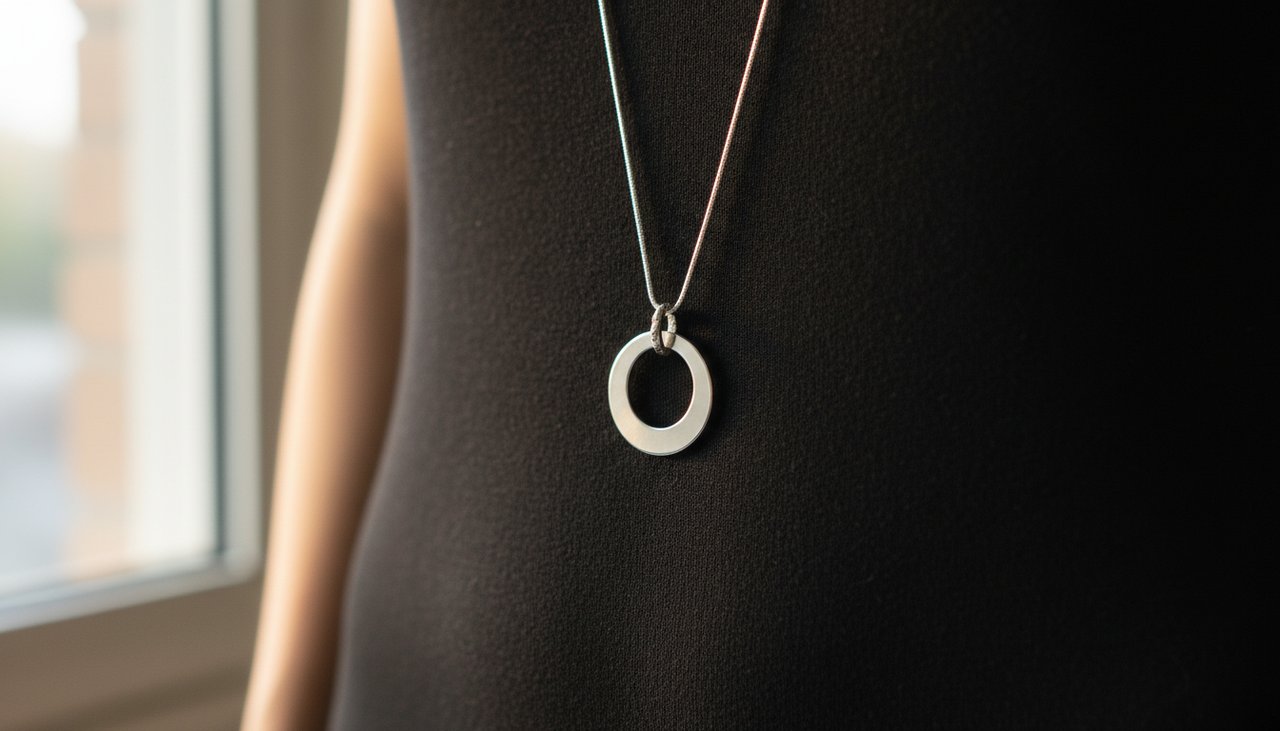
A single pendant against dark fabric can draw the eye to one point. Where that point lands has something to do with chain length — and which length feels right can depend on the neckline.
- A shorter chain sits closer to the collarbone. Some people pair this with V-necks and scoop necks, where the neckline already opens the chest area.
- A mid-length chain sits a little lower. It’s a common choice for crew necks and many everyday dress cuts.
- A longer chain drops further toward the sternum. This can suit open or lower necklines, where there’s more bare skin for the pendant to sit against.
Some people notice that a polished finish reads brighter against matte black fabric, while a brushed or oxidized surface sits quieter. Preferences here vary — against black silk, a polished piece may feel more noticeable, while against black wool or knit, a brushed finish might blend more easily with the fabric’s texture. There’s no single right pairing, just different looks to try.
The Ellipsis
Fingers move across a keyboard. Thin silver rings can catch light in sequence as the hand shifts — one on the index, one on the middle, one on the ring finger. The result is a trail of small reflections rather than one fixed point, following the hand’s motion.
Band width can change how a stack reads. Thinner bands tend to stack with less visual weight, while wider bands can stand out more on their own — stacking several wide bands together may feel like a lot, depending on personal taste. One approach some people use is pairing a single wider band with a couple of thinner ones, though this is just one option among many.
- Some people match band widths within a stack for a more uniform line, while others prefer mixing widths.
- Spreading rings across more than one finger is one way to distribute the look across the hand.
- Varying surface finish — one smooth, one lightly hammered — is another way to add contrast without adding more pieces.
- Before buying, checking ring size for each finger separately can be useful when stacking across multiple fingers.
The Comma
Effective styling treats jewelry as a tool for composition rather than a decorative afterthought.
A hand reaches across a counter. A thin silver chain at the neck can reflect a similar cool tone to a ring on the finger. The eye may move between them more easily — not necessarily because the pieces match, but because they share a similar metal tone.
Sterling silver is a widely used alloy in jewelry making. Polished sterling silver often reads cooler against black than yellow gold or warmer plated finishes, though this can vary by piece and lighting. Some people find that tonal consistency between a necklace and a ring creates a sense of connection, even without a matching set. The pieces can come from anywhere — staying in a similar color register is one way to link them.
The Em Dash
One hand carries a few stacked rings. The other is bare, reaching up to tuck a strand of hair. The contrast can be noticeable — one side carries more visual weight, the other feels more open.
This kind of contrast can read more clearly when the dress itself is fairly plain. A simple shift or a minimal column cut may let the asymmetry stand out more. Add structure or surface detail to the fabric and the effect can get absorbed into the rest of the outfit. Negative space is one of several factors that can influence how the silver reads.
Keeping Silver Ready to Wear
How silver looks over time can depend on the piece, how often it’s worn, and its finish. People take different approaches to keeping their silver jewelry looking the way they like — what works well for one piece or one person isn’t necessarily the right approach for another, especially when finishes, settings, or stones are involved.
- Some people use a soft cloth on smooth, high-polish surfaces as part of their regular routine.
- For any cleaning product, check the maker’s guidance for the particular finish and construction before trying it.
- For pieces with stones or unfamiliar construction, ask the maker or a jeweler before choosing a cleaning method.
Storage habits also vary — some people keep pieces separate from one another, others don’t. When it comes to keeping silver looking the way you like, checking with the piece’s maker or a jeweler about what suits that specific item is often more useful than a one-size-fits-all approach.