

A pair of wrists rests lightly on a silver laptop keyboard in a quiet cafe. With every keystroke, a cluster of metal bracelets clinks against the aluminum chassis, as if forcing the typist to adjust their arm again and again. This friction highlights a physical reality we often overlook when getting dressed: jewelry isn’t just about how it looks, but how it moves.

Most people err on the side of adding more, not less. The hesitation usually isn’t about taste — it’s about not knowing how to effectively stack bracelets without interference. Layering jewelry involves thinking about spatial limits and material weight, a kind of informal physics of the wrist. When your accessories get in the way of basic movements, the arrangement is worth reconsidering.
The One Third Rule
Your lower arm has a specific spatial geometry. A stack that extends beyond one-third of the distance from your wrist bone to your elbow crease can start to change how balanced the arrangement feels on your limb. Staying within this boundary is one way to keep your arm looking like it moves naturally, rather than feeling visually weighed down by excess mass.
When metal covers a large surface area, the stack can start to look overcrowded. Keeping your pieces within this lower zone is one way to keep the natural taper of your arm visible. Just as you might find ring size to help a piece sit better without slipping or constricting, measuring the forearm coverage is a way to gauge overall visual balance.
To get a feel for this boundary, you can measure the coverage area against your forearm. Many people prefer to leave some breathing room so the stack has a less crowded visual balance.

- Locate the distance between your wrist bone and the inner elbow crease.
- Some people divide this measurement by three as a rough styling guideline for a lighter coverage zone.
- Leave at least two centimeters of bare skin visible within the stack if you prefer a lighter look.
Material Ratio
Light interacts differently with various surface tensions. When ambient light hits multiple identical metallic finishes, the reflections can compete and scatter. Establishing a structural formula is one way to help manage this dispersion. Even if you silver jewelry clean regularly to maintain a clear reflection, the visual hierarchy still comes from how different textures interact with each other.
The 70/20/10 material formula is one optional styling approach for managing visual weight. It treats a primary metal, a contrasting texture, and a small accent as different proportions rather than a fixed rule. Some people find this kind of balance useful when coordinating jewelry black outfit pairings, where the contrast between metal and fabric is more noticeable.
Imagine two smooth silver-tone chains paired with a matte cuff and a single organic-shaped bead. The matte and textured elements can interrupt the glare of the polished metal, giving the eye a resting spot. Stripping away competing finishes is one way to ease some of that visual tension.
Metal density can also affect how a stack feels in practice. A solid gold cuff is roughly fifty percent denser by volume than a sterling silver piece of similar dimensions — 18k gold sits at around 15.5 g/cm³ against sterling silver’s roughly 10.5 g/cm³, so a gold piece can weigh noticeably more for the same size. When building a stack, mixing a gold accent with lighter silver or titanium pieces is one approach some people use to help balance the total weight without reducing the visual presence of the arrangement.
Acoustic Test
Sound can be one indicator of physical contact between pieces. The high-frequency clatter of metal edges can register clearly in quiet offices or dining rooms. These environments may reveal whether your jewelry is producing more noise than you’d like during routine gestures.
This test relies on the general idea of dampening vibrations. When hard metals collide, they can produce sharper sound waves that some people find cluttered or distracting. Controlling this is mostly a matter of separating the hardest surfaces from each other.
Introducing a buffer material is one way some people try to soften the collision. Inserting a woven cord or a thin leather band between two rigid metal cuffs may help absorb some of the impact. This kind of change can turn a sharper impact into a quieter, lower sound.
Discreet silicone O-rings placed on rigid pieces are sometimes used as a similar kind of buffer. This kind of small adjustment is one way people try to help their jewelry sit a little more quietly during the day.
Protect the Watch
A wristwatch adds some mechanical complexity and its own material considerations. Watch cases are sometimes described as more prone to scratches from contact with harder metal edges, per general guidance around the Mohs scale of mineral hardness. Some people prefer a deliberate spatial strategy to help protect a timepiece they care about.
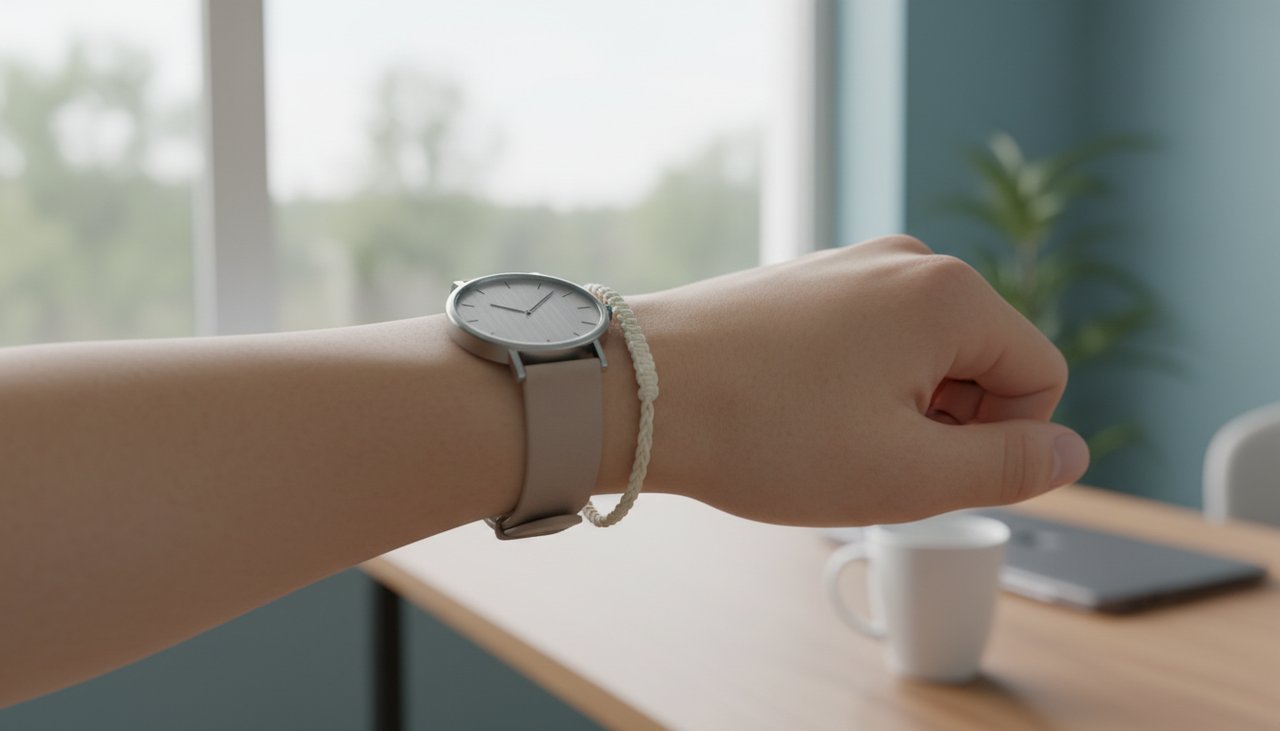
One straightforward approach is to keep pieces on separate arms. Moving auxiliary pieces to the opposite arm can help reduce the chance of contact and abrasion. If you prefer keeping items on the same side, a protective barrier is one option worth considering.
A soft textile band placed directly against the watch case can act as a physical buffer against metal links. This may help reduce the amount of direct contact between the case and other pieces as your arm moves through the day.
You may want to avoid placing chain-link bracelets or items with sharp angles directly against a watch face. Repeated contact from constant movement can increase the chance that these edges leave marks on the steel or sapphire over time.
Daily Activity Check
One informal way to check a stack is to see how it holds up during ordinary daily tasks. Some people prefer jewelry that adapts to their environment rather than asking them to adjust their posture around it. Two simple scenarios can offer a quick, informal read on how a look feels day to day.
The laptop test looks at thickness. Rest both arms naturally on a flat keyboard. If the bottom of your bracelets tilts your hands upward or presses against the desk, you may find the base feels too thick for your liking.
The sweater test looks at surface friction. Pull a knit garment over your hand. If the fabric catches on a clasp or setting, you might consider simplifying the arrangement.
The most natural stack is the one you forget you are wearing.
Space, weight, and sound can offer practical cues that style alone does not show. If the stack needs constant adjustment during ordinary tasks, simplify it or change the arrangement; the useful result is the one that suits your own routine.