

Jewelry worn every day behaves differently from jewelry that spends most of its time in a box. A piece worn occasionally stays closer to its original condition; a piece in daily rotation is exposed to more contact, more friction, and more handling. Matte steel bands and flat-link chains are two categories built around that kind of frequent wear, and understanding how their materials, finishes, and construction respond over time can help set realistic expectations before buying. Knowing how to clean jewelry at home is part of keeping these pieces looking their best as part of a daily routine.
One consideration with any piece worn often is that a finish is not necessarily a fixed, unchanging state. Expecting a surface to look exactly the same after months of contact with skin, fabric, desks, and other objects can be at odds with how metal finishes actually behave under repeated use.
Material and finish choices matter because they affect how a piece is likely to look and hold up with regular wear. The following points cover some general characteristics of matte steel bands and flat-link chains as material, finish, and construction categories.
The Unavoidable Polish of Daily Life
A brushed finish is commonly made with fine, directional abrasion marks on the metal’s surface. Matte finishes can be created in different ways, but both may scatter light rather than reflecting it in a single direction. Over time, localized areas of a textured surface can gradually change through contact with other surfaces.
Repeated friction against a desk edge, a keyboard, fabric, or other everyday surfaces can alter the texture at the specific points where contact happens most, developing a smoother, slightly glossier patch rather than a scratch or gouge. This is a general characteristic of brushed finishes on metals such as stainless steel and titanium, not a defect limited to a single piece. How much a given band changes, and how quickly, depends on the alloy, the specific finishing process used, and how and where it makes contact during regular wear.
A matte finish is a starting point, not a permanent state.

Understanding that a matte finish can evolve with wear reframes early surface changes as an expected characteristic of the material rather than damage. The finish responds to the specific contact points and habits of whoever is wearing it, which is part of how brushed metal finishes behave over time rather than a flaw in a particular piece.
A Flat Chain Must Earn Its Place
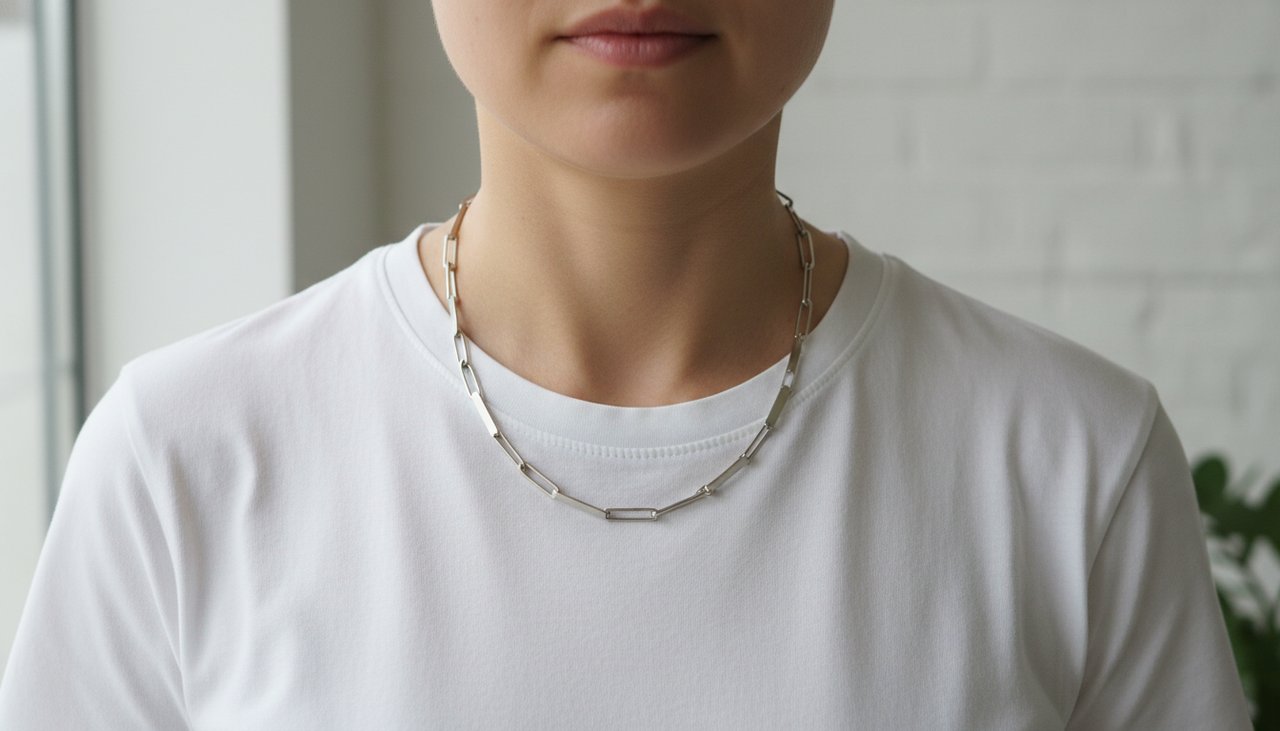
Flat-link chains are sometimes assumed to sit flush against the skin simply because the individual links are flattened. In practice, whether a chain lies flat depends on more than the shape of a single link. Construction details — whether the links are solid or hollow, how tightly they connect to one another, and how weight is distributed along the chain — all play a role.
A chain that looks flat in a photograph does not necessarily have the mass to settle consistently against the body. Hollow-link constructions are generally lighter than solid ones of similar dimensions, and lighter chains can be more prone to twisting or flipping with movement of a collar or shirt. A solid-link chain typically carries more mass than a hollow one of comparable size, which can make it less prone to shifting, though outcomes still vary by design, link size, and how the chain is worn.
Because chain behavior varies by construction, a few physical checks can give a general sense of how a given chain is likely to sit:
- Hold it by one end to see whether it hangs straight or twists.
- Check whether the links are solid or hollow, since this affects overall weight.
- Look at how tightly the links are connected, since looser connections allow more rotation.
Ring Interior Profiles
A wide steel band can look substantial on the hand, but visual weight and physical comfort are not the same thing. Interior geometry plays a role alongside width: a ring with a flat interior profile has more surface area in direct contact with the finger, which can create noticeable pressure points for some wearers, particularly around the knuckle, when gripping objects or during ordinary hand movement.
Because comfort depends on hand shape as well as ring design, it can help to find ring size accurately and to think about how a given band’s interior profile might interact with your own grip and finger shape.
A curved, or rounded, interior profile reduces the sharp transitions found in a flat interior, spreading contact more evenly across the width of the band. This is a common design approach on wider bands specifically because a larger flat surface has more area available to create pressure points. How comfortable any particular ring feels still depends on the wearer’s hand and how the ring is sized.
Running a thumb along the inside edge of a wider band can give a general sense of whether the interior is flat or rounded, which is one factor — among others — worth considering before choosing a design.
The Quiet Light of Matte Surfaces
Polished metal surfaces are smooth at a microscopic level, so light reflects at consistent angles and produces sharp highlights and glints. This is known as specular reflection. Matte or brushed surfaces are covered in fine, irregular abrasion marks that scatter incoming light in many directions instead of reflecting it as a single point, a property called diffuse reflection. While you might stack bracelets in a mix of finishes, this difference in light behavior is one factor that affects how a group of pieces reads together.
The practical result is a softer, less directional glow rather than a sharp reflection. Under bright or uneven lighting, such as fluorescent office lighting, a polished surface tends to throw visible glints across a room, while a matte surface holds a more even, ambient tone without the same sharp highlights.
Polished and matte finishes reflect light differently.
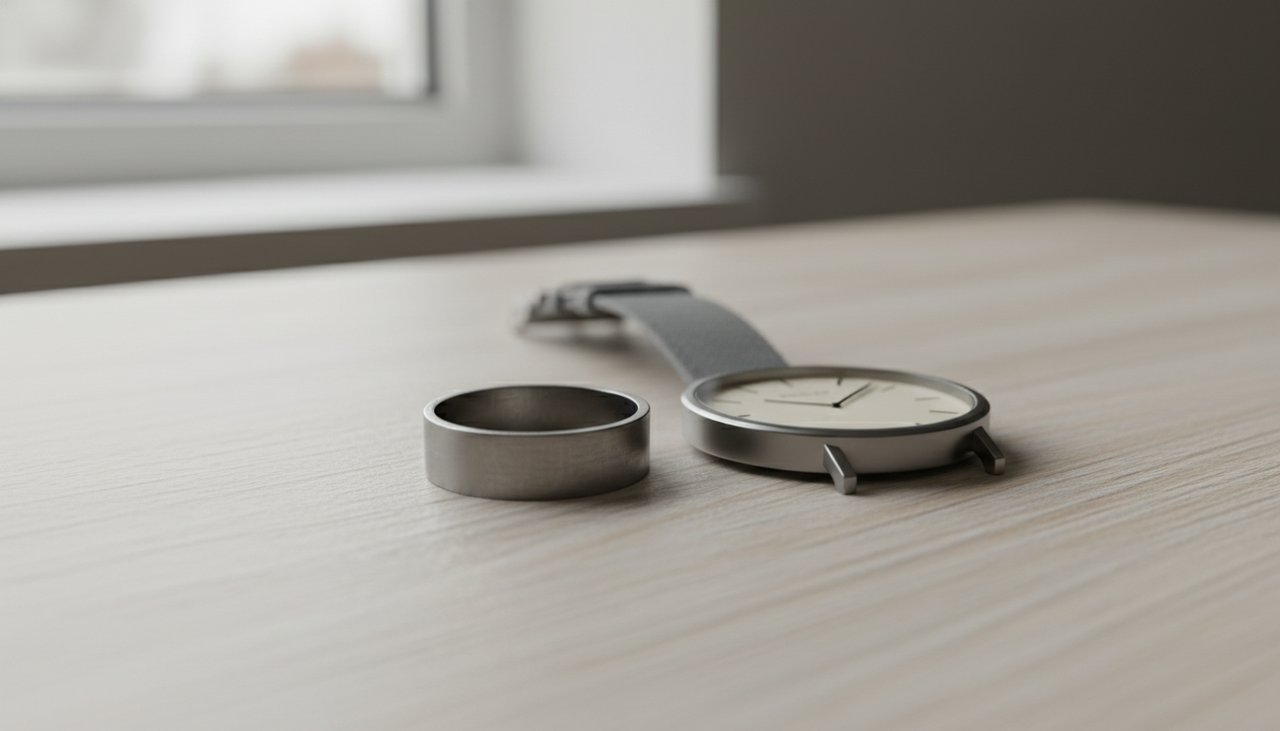
Because matte surfaces can produce less directional glare, they may read as more subdued in everyday settings and can pair well with lower-contrast outfits, such as a jewelry black outfit. This is a stylistic characteristic rather than a fixed rule — polished and matte finishes each behave differently under light, and which one suits a given look depends on the rest of the outfit and setting.
Choosing matte steel bands or flat-link chains for daily wear involves weighing material, finish, and construction against how a piece will actually be used: friction from repeated contact, chain weight and link type, ring interior profile, and how a given finish interacts with light are all part of that picture.
Over time, a matte finish may develop localized changes in texture, and a chain’s fit against the body depends on its specific construction rather than its link shape alone. Considering these material and construction factors in advance can help set expectations for how a piece is likely to look and behave as part of a daily rotation.